
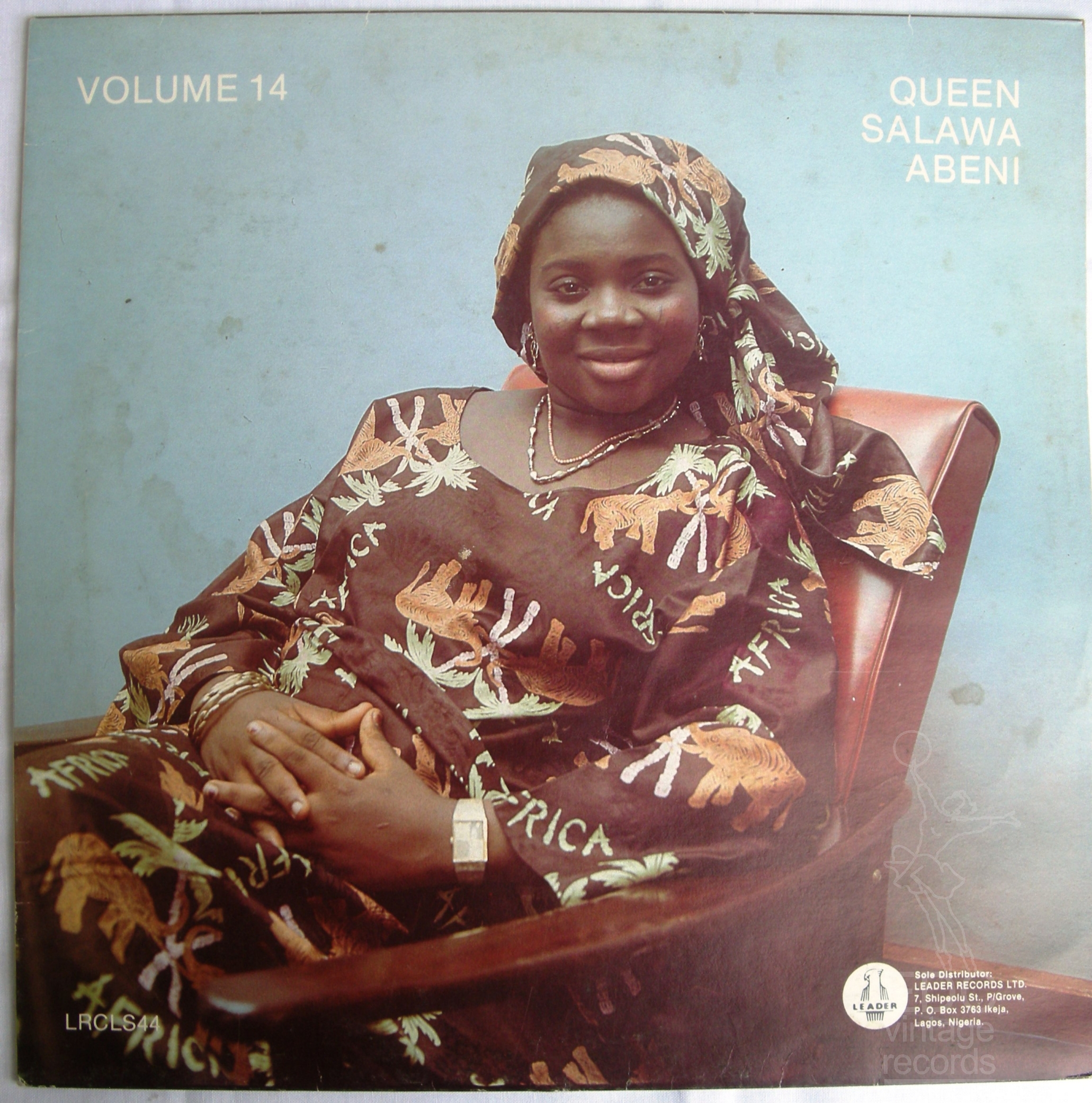
Salawa Abeni Alidu was born on May 5, 1961, in Epe, Lagos State. Her roots trace to Ijebu Waterside in Ogun State, the ancestral home of her Ijebu Yoruba lineage. She did not come from Lagos studios or privileged circles. Her early years were spent as a housemaid in the home of Mr. and Mrs. Ganiyu Otun at Ipogun, under Epe. It was in that modest setting that one of Nigerian music’s most important voices first took shape.
Waka is an Islamic-influenced, traditional Yoruba music style — older than both Jùjú and Fuji — rooted in women’s asalatu gatherings, mosque ceremonies, and social functions. Its call-and-response structures, percussion drive, and moral-poetic depth had largely belonged to women’s spheres for generations. Before Salawa, its greatest standard-bearer was Alhaja Batile Alake, the Iyalaje of Ijebu-Igbo and the first Waka singer to record commercially. In 1956, she was among the musicians who performed for Queen Elizabeth II during the British monarch’s visit to Nigeria. Despite Alake’s achievements, Waka remained largely intimate and ceremonial in the popular imagination — even as King Sunny Ade, Ebenezer Obey, and Sikiru Ayinde Barrister commanded the airwaves in the male-dominated mainstream.
A teenage girl from Epe would change that.
Salawa began singing informally at around age nine, performing at community events and mosque gatherings. Her voice drew notice from those around her, including a headmaster, Mr. Shobowale, who visited the Otun household and urged that the girl be encouraged in her education. Around 1974, when she was approximately thirteen, she was spotted by Lateef Adepoju, a businessman and music enthusiast who owned Leader Records, at a performance in Lagos. He recognised her raw Waka talent and, after months of negotiation with her family, signed her to his label. Her father’s opposition was real — he had watched one of his children enter the music world already and worried about the path it represented for a young girl, warning her mother that she had not yet reached twenty. But Salawa’s determination, and the encouragement of those around her, prevailed.
In 1976, not yet fifteen, she released her debut album: Late General Murtala Ramat Mohammed, a tribute to the Nigerian head of state assassinated in February of that year. The album sold over one million copies in Nigeria, the first time a female Yoruba artist had achieved that figure. It broke through a ceiling that the male-dominated Jùjú and Fuji industry had kept firmly in place.
She has described those early years as a constant struggle for a young girl trying to find her footing in a male-dominated industry.
A string of albums under Leader Records followed — including Iba Omode Iba Agba, among others — that demonstrated her range across social commentary, Islamic-inflected devotion, love, and politics. Where male stars like Shina Peters would later bring a contemporary injection to Jùjú, Salawa had already done the same for Waka, years earlier and under more difficult conditions.
Record Deals, Power Structures, and the Long Shadow
Salawa’s career shows how record deals and industry structures shaped — and often exploited — artists who lacked the power to protect themselves. Signed as a teenager to Leader Records, she delivered historic commercial success and released sixteen albums under Adepoju’s imprint. Yet she has said in interview after interview that she saw little to nothing in royalties from her early recordings. “I was still a young girl then and living in the village with my husband,” she told the Saturday Sun in 2026. “I didn’t know anything then. My job was to release songs and albums. I didn’t even know what royalties meant.”
Her association with Adepoju was personal as well as professional. By the mid-1980s, the relationship had run its course, producing a son, Idris Olanrewaju Adepoju. Even after Adepoju’s death, his family contested Salawa’s access to her own master tapes, despite his will reportedly naming her son as a beneficiary. The tapes, she has said, remain out of her reach.
Before that relationship fully closed, a new chapter opened. In the early 1980s, a feud erupted between Salawa and Fuji heavyweight Kollington Ayinla, conducted through records. She released Ikilo (“Warning”) as her public broadside; he responded in kind, and the exchange escalated across multiple releases. The feuding artists eventually became lovers, then husband and wife. In 1986, Salawa left Leader Records, ending her relationship with Adepoju, and joined Kollington’s imprint, marking the move with Ife Dara Pupo (“Love Is Very Good”). That same year, she also released Indian Waka, riding the wave of Bollywood’s popularity in Nigeria at the time. She remained with Kollington Records until 1994, releasing a further eight to ten albums in that period.
What Came After: Albums, Loss, and Resilience
By the time her marriage to Kollington ended in 1994, Salawa had released twenty-seven albums. She continued recording independently through the rest of the decade, had a stint with Sony Music releasing the cassette Beware (1995), and has built a discography that now exceeds forty albums by her own count.
The decade closed with tragedy. On October 2, 2000, her first son, Idris Olanrewaju Adepoju, died in a car crash on the Lagos-Ibadan Expressway. He was seventeen. The loss, Salawa has said, changed her life completely and affected her career in ways she is still carrying. “Your death caused a lot of pains in my life,” she wrote on the twentieth anniversary of his passing. “It still feels like yesterday.”
She has navigated health battles, the difficulties of raising children largely alone after separations, and an industry that consistently undervalued the catalogue she built. Her own explanation for how she continued has stayed consistent: “My ‘medicine’ is prayer.”
In 1992, the Alaafin of Oyo, Oba Lamidi Adeyemi III, crowned her Queen of Waka Music, a formal recognition of what Nigerian audiences had long already decided.
Contemporary Echoes: The Remix, the Cover, and the Living Influence
Her son, Big Sheff — her child by Kollington Ayinla — released a remix of her classic “Gentle Lady” in 2019, with Salawa featuring. The track blends her original Waka vocal delivery with contemporary rap production, introducing her to a generation that had only inherited the legend secondhand. While “Gentle Lady” remains a fan favourite, it is “Congratulations,” from her 1991 album of the same name, that Salawa has pointed to as the song closest to her heart. “All my albums made me famous, but ‘Congratulations’ was the one people really loved,” she told the Saturday Sun in 2026. “Out of the more than 40 albums I have released, that song remains special.”
In September 2024, Salawa recorded her own cover of Asake’s “Fuji Vibe,” a track from his third album Lungu Boy, and posted it on Instagram. At 63, she delivered a spirited Waka-inflected version of the record, adapting the production to her register while keeping Asake’s melodic structure intact. The cover went down well online — a reminder that one of the women who built the Fuji-adjacent tradition a contemporary superstar was drawing from is still active, and still watching.
Citations & Reference links
The Sun Nigeria (Saturday Sun) — “I was a housemaid before fame” – Salawa Abeni
City People Magazine — “How I Started Singing WAKA At Age 13 – Queen SALAWA ABENI”
November 8, 2021
allAfrica.com (via P.M. News) — “Salawa Abeni Loses Son To Auto Crash”
October 12, 2000
Linda Ikeji’s Blog — tribute post reproducing Salawa’s Instagram caption on Idris’s 20th death anniversary
October 2, 2020
NotJustOk — “Nigerian legend Salawa Abeni sparks reactions with her cover of Asake’s ‘Fuji Vibe'”
September 10, 2024
Wikipedia — Salawa Abeni (discography section)
Discover more from Nigerian Sounds
Subscribe to get the latest posts sent to your email.