
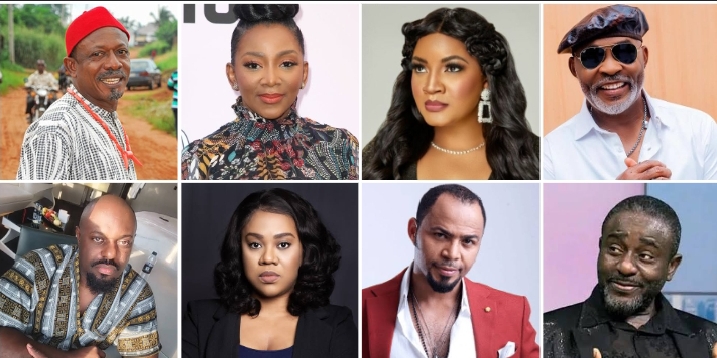
In September 2004, as tensions sharpened between Nollywood actors and film marketers, eight high-profile names—Genevieve Nnaji, Omotola Jalade-Ekeinde, Ramsey Nouah, Richard Mofe-Damijo, Emeka Ike, Stella Damasus, Jim Iyke, and Nkem Owoh—were effectively barred from many productions in a marketers-led sanction that lasted about a year. The dispute centred on rising fees, control within the production chain, and the actors’ preference for distributors who paid upfront. It was a significant industry rupture, arriving at a moment when Nollywood’s release rhythms, star system, and sound culture were already beginning to shift.
The G8 episode did not create a lasting actor-musician tradition, but it did open one of Nollywood’s most revealing side chapters: a brief period when some of its biggest stars tried to carry screen fame into recorded music. Some of those projects were fleeting and experimental. Others endured in cultural memory because they extended familiar screen personas into song at exactly the right moment.
That crossover did not emerge from a vacuum. Nollywood had long leaned heavily on music, drawing emotional force from original themes, recurring motifs, and the work of prolific soundtrack figures such as Stanley Okorie, whose vast catalogue helped define the texture of the home-video era. By the mid-2000s, however, that indigenous scoring culture was increasingly under pressure, as foreign tracks and club hits began filling spaces once occupied by more purpose-built original music. The G8 moment belongs within that broader transition rather than standing apart from it.
Single Releases: The Tracks That Found a Place in Memory
Genevieve Nnaji’s “No More,” the lead single from her late-2004 debut, remains one of the more memorable entries from this period. Released through Ghana’s EKB Records, the song blended English and Igbo within a soft, relationship-centred pop frame, while its video borrowed the emotional pacing of a miniature Nollywood drama. Reception was mixed, but the song lingered. It felt polished, deliberate, and carefully packaged—less like a novelty and more like a serious attempt to test how far screen celebrity could travel into musical fame.
Omotola Jalade-Ekeinde’s move into music was more sustained. Songs such as “Naija Lowa,” “The Things You Do to Me,” and the later “Feel Alright” suggested a performer genuinely interested in building a parallel recording identity rather than merely attaching her name to a one-off single. Yet even when the ambition was evident, the music never quite matched the scale of her screen presence. What it offered instead was a revealing extension of the Omotola persona: poised, glamorous, self-assured, and emotionally legible in the way popular stardom often demands.
Nkem Owoh’s “I Go Chop Your Dollar” followed a completely different path. Satirical, sticky, and inseparable from the Osuofia character, the song engaged directly with 419 culture and quickly became one of the era’s most discussed crossover records. Released in connection with the 2005 film The Master, it travelled widely in Lagos and beyond, less because it aspired to conventional pop sophistication than because it understood exactly what audiences already recognized in Owoh: comic timing, vernacular ease, and the power of caricature sharpened into social commentary. Its mocking treatment of advance-fee fraud drew official scrutiny, and the National Broadcasting Commission, alongside the EFCC, moved against its airplay. Yet the restriction did not silence the song. It continued to circulate through film, CDs, and word of mouth, securing a cultural afterlife that outlasted many more polished efforts.
Albums: Production, Themes, and the Work That Endured
Genevieve’s One Logologo Line was a compact eight-track project that leaned into R&B, hip-hop, and urban pop. What distinguished it from many celebrity side projects of its time was not only its sound but its framing. The Ghana-Naija collaborative structure gave the album a cross-border identity and a degree of musical scaffolding that many Nollywood crossover attempts lacked. It suggested planning, industry support, and a market imagination wider than the immediate video-film circuit.
Omotola’s Gba, released in 2005, was the clearest statement of her recording ambitions. Later work, including Me, Myself & Eyes in 2010, brought in producers and collaborators from across Nigeria’s pop landscape, among them Paul Play Dairo, Del B, Modenine, Teeto, and Harrysong. Across those recordings, she leaned into themes of confidence, romantic control, and self-possession—qualities already familiar from her screen image. If the albums did not transform her into a dominant music star, they still revealed a performer trying to shape a coherent identity across mediums.
Jim Iyke’s Who Am I?, which featured 2Face Idibia and Sound Sultan, now reads less as the beginning of a music career than as a star experiment testing the outer limits of celebrity. The guest list was impressive on paper, but star power alone could not guarantee artistic conviction. Iyke himself later reflected on the experience with striking self-awareness, describing the process as humbling and joking that he was “probably the worst rapper.” That candour is part of what makes the project interesting in hindsight: not as a failed reinvention, but as evidence of how porous entertainment boundaries briefly felt in that era.
Nkem Owoh’s later I Go Chop Your Dollar EP extended the Osuofia brand into music without pretending to be anything else. It functioned less like a conventional artist project than like an extension of a comic universe audiences already understood. That was its advantage. Where other actor-musicians had to persuade listeners to accept a new persona, Owoh simply intensified an existing one.
Collaborations and Features
The collaborations behind these projects reveal different strategies. Genevieve’s album drew from a clear regional network, with appearances from Obour, Kojo Antwi, and VIP. Those Ghana-Naija links gave the project a stronger musical frame and a broader commercial outlook than many Nollywood crossover efforts could access at the time.
Omotola’s collaborations were more locally rooted but still genre-spanning, placing her work between pop, hip-hop, and softer adult-oriented contemporary sounds. The guest choices positioned her close to the centre of Nigerian commercial music without fully converting that proximity into a defining musical breakthrough.
Jim Iyke’s project arguably had the strongest guest list on paper, but its most enduring value lies in what it exposed: celebrity could open studio doors, yet it could not substitute for a clear sonic identity. Nkem Owoh, by contrast, needed no features. The strength of his music lay in the consistency of the Osuofia persona, which moved naturally from screen to recording.
Record Label Affiliations: The Structures Behind the Releases
The release structures behind these records also mattered. Genevieve’s link to EKB Records in Ghana gave One Logologo Line a more formal and market-ready presentation than many comparable efforts emerging from Nollywood at the time. It looked and sounded like a project designed for circulation beyond the local film-market ecosystem.
Jim Iyke’s music moved through his own Untamed platform, reflecting an attempt to build a parallel outlet beyond acting. Omotola’s releases, meanwhile, were shaped more by individual producers and project-based affiliations than by a stable label identity, which helps explain both their flexibility and their uneven long-term imprint. For Nkem Owoh, the logic was different again: the recordings functioned less as label-driven career moves than as direct extensions of the Osuofia brand.
Enduring Legacy: A Chapter in the Nollywood-Music Relationship
In retrospect, the G8 episode did not end the careers of the actors involved, nor did it create a durable pipeline from Nollywood stardom to music success. What it did reveal was a brief and fascinating permeability between screen fame, soundtrack culture, and commercial experimentation. Some releases were quickly forgotten. A few survived because they tapped something larger than celebrity curiosity—humour, controversy, regional collaboration, or the emotional familiarity of a persona audiences already loved.
That distinction matters. Nollywood has always had a deep relationship with music, but the actor-as-recording-artist model remained uneven and exceptional rather than dominant. The more enduring tradition lay elsewhere: in the ecosystem of soundtrack makers, composers, and recurring sonic motifs that gave the home-video era much of its emotional charge. As the industry changed—through new stars, new financing structures, and the growing global reach of Nigerian entertainment—that earlier soundtrack culture also changed, becoming less central to mainstream Nollywood identity even as film music itself never disappeared.
Seen in that light, the G8 moment now reads less as the birth of a trend than as a revealing flashpoint in a longer history. It was a moment when the boundaries between acting, music, branding, and popular memory briefly loosened. Genevieve offered polish and cross-border ambition. Omotola pursued the most sustained musical extension of her star image. Jim Iyke embodied the risk and vanity of celebrity crossover. Nkem Owoh achieved what the others, in different ways, only approached: a song that fused character, satire, and circulation so effectively that it escaped the limits of the experiment itself.
What remains today is not a tradition of Nollywood stars casually becoming recording artists, but a set of artifacts from a transitional era—records, videos, catchphrases, and public personas that captured an industry in motion. That is why this chapter still matters. Not because it changed Nollywood forever, but because it preserved, in musical form, the restless improvisation of an entertainment culture learning how far its stars could travel.
Citations & Reference links
Pulse Nigeria — “13 years ago, 8 A-List actors were banned from Nollywood”
Glitz Africa Magazine: 25 years of the iconic Omotola Jalade-Ekeinde
Al Jazeera: New millionaires, new music: How cybercrime was codified into Afrobeats
TheCable Lifestyle: ‘I was the worst rapper ever’ — Jim Iyke talks music stint
Discover more from Nigerian Sounds
Subscribe to get the latest posts sent to your email.