
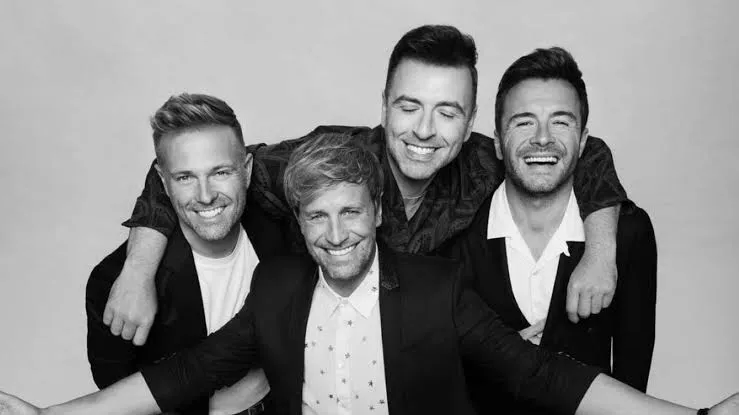
Who is Westlife ?
Westlife, the Irish pop quartet formed in Dublin in 1998 by Shane Filan, Mark Feehily, Kian Egan and Nicky Byrne (with Brian McFadden as a member until March 2004), achieved an unexpected degree of mainstream traction in Nigeria during the late 1990s and early 2000s. Though the group disbanded in 2012 and later reunited in 2018, their music continued to circulate widely across Nigerian airwaves long after their initial wave of global fame, with music programmes playing many of their songs during Thursday Throwback editions. This enduring presence in Nigeria was driven less by major-label marketing than by the grassroots mechanics of local distribution networks and the simple appeal of their melodic balladry.
Distribution and Cultural Appeal
In an era before streaming, pirated CDs served as the primary medium for international pop music in Nigeria. A Nigerian pirate distributor, known colloquially as Big Boss Jigga Man—the Alaba Music Kingpin—was instrumental in circulating Westlife’s albums throughout urban and rural markets. These affordable copies made Westlife’s songs accessible to a broad Nigerian audience, from the bustle of Lagos markets to small-town corner shops. Radio stations regularly featured tracks like “Flying Without Wings” and “Uptown Girl,” further embedding them in local listening habits. The appeal of Westlife in Nigeria rested on a convergence of factors: their polished harmonies and emotionally direct lyrics, the visual allure of their music videos, and a cultural context that embraced romantic pop songs as part of courtship rituals. It became a lighthearted truism that familiarity with Westlife lyrics was almost a prerequisite for young men hoping to impress potential partners. Lyric booklets of their greatest hits circulated among students and young people alike, who learned lines by heart as a form of social currency. On televised talent shows—including Nigerian Idol, Voice Nigeria and MTN Project Fame—contestants frequently selected Westlife covers to showcase their vocal range and emotional delivery, underscoring the band’s role as a benchmark for pop-ballad performance.
Influence on Nigerian Artists
Westlife’s Nigerian legacy extends beyond mere nostalgia. Their influence contributed to a late-’90s and early-’00s R&B-pop renaissance in Nigeria, exemplified by local male vocal groups such as Styl-Plus. Contemporary Nigerian artists such as P-Square sampled Westlife’s “Soledad” on their 2005 album Get Squared. More recently, singers including Adekunle Gold and Johnny Drille have recorded covers of Westlife songs as a nod to the band’s impact, with these artists citing them as influences. Even slang expressions—like “Wetin Westlife no go see for empty street,” playfully mimicking the band’s romantic lyricism of the hit track “My Love” —have found currency in Nigerian vernacular.
Enduring Legacy
Despite selling over 55 million records worldwide and achieving fourteen UK No. 1 singles—alongside four Guinness World Records—Westlife’s penetration of the U.S. mainstream remained limited. Their only Billboard Hot 100 entry, “Swear It Again,” peaked at number 20 in 2000, and subsequent singles did not chart. In contrast, the relative ease of distribution via pirated CDs and a receptive pop-ballad audience in Nigeria allowed Westlife’s music to flourish far more extensively than in some major markets. While they never officially toured Nigeria, the combination of grassroots CD circulation, radio airplay and fan love ensured that Westlife’s voice continued to echo across the country, solidifying their reputation as one of the most influential foreign pop acts in Nigeria’s turn-of-the-decade music scene.
Discover more from Nigerian Sounds
Subscribe to get the latest posts sent to your email.