
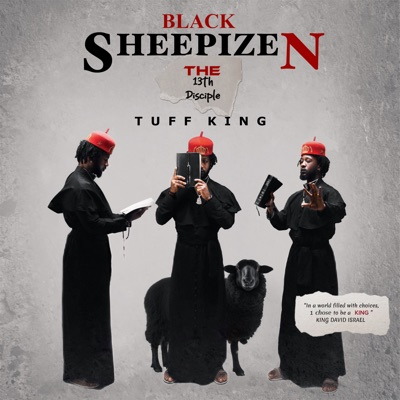
Artiste:- Tuff Kingg
Album:- BLACK SHEEPIZEN (THE 13th DISCIPLE)
Record Label:- Black Sheep Pen
Distributed By: Inglemind
Guest Appearances:- Phyno
Producers:- mxlvyn , Saint6
Release Date:- February 20, 2026
The Viral Spark
Before he was topping charts, Tuff King became a digital ghost in the machinery of Nigerian social media. His breakout hit, “Nkemakonam,” was initially received by non-Igbo speakers as a “funny-sounding” novelty. However, it quickly morphed into a TikTok juggernaut. The track became the definitive soundtrack for videos of people “fooling themselves” or navigating awkward, chaotic situations—often tagged with the viral slang, “everywhere go just blur.” What began as a comedic trend soon revealed a gritty, raw, and aggressive Igbo rap style that the mainstream could no longer ignore.
This recent momentum carried into his 2024 body of work, BLACK SHEEPIZEN, which defied the odds by climbing to the #2 spot on Apple Music Nigeria. As of early 2026, “Nkemakonam” has amassed over 4.5 million streams on Spotify, while “Suppressed Desires” topped the Shazam Top 200 Nigeria chart—proving that the “Black Sheep” has finally found his flock.
Behind the moniker and his Artistry

Behind the moniker is King David Israel, a rapper and executive producer born and raised in Abakpa Nike, Enugu State. Growing up in an environment characterized by social instabilities, Israel’s music acts as a narrative-driven reflection of the “dark side” of a bleeding city. His “Black Sheep” identity is a calculated move to distinguish himself from the polished mainstream. Much like Odumodublvck, he wears the “outsider” tag as a badge of honor, operating strictly on his own terms.
Sonically, Tuff King is a fascinating “love child” of Odumodublvck and Black Sherif. He embodies the aggressive, gritty delivery of the former but maintains the raw, unpolished and soulful storytelling of the latter. When he switches to a more English delivery, he reveals an ‘inner Busta Rhymes”—a rapid-fire, foreign-sounding cadence that bridges the gap between Enugu streets and American rap aesthetics.
Album Analysis
The project opens with the viral track “Nkemakonam,” which serves as both an introduction to Tuff King’s sonic identity and a manifesto for his persona. By leaning into the phrase “bla bla black sheep,” King immediately adopts the role of the misunderstood outsider, flipping the “black sheep” label from a stigma into a mark of independence and sarcastically asking his detractors, “Are you feeling good?” to check if they’ve reached satisfaction in their attempts to judge him. Musically, Tuff King presents as a new-school love child of Odumodublvck and Black Sherif, embodying the aggressive, gritty rap style of Odumodublvck but delivering it with a raw, unpolished urgency reminiscent of Black Sherif’s early work. At its core, “Nkemakonam” is a defiant prayer of self-preservation—a “hustler’s anthem” that meticulously balances the gritty reality of daily labour with a high level of spiritual confidence. The track acts as a shield against Asili (gossip), focusing on the social friction that inevitably follows success with a philosophy of pure pragmatism: “As long as I can still eat and provide for myself (ife mma-eri akonam), your words have no power.” This reflects a classic Nigerian perspective that unapologetically prioritises tangible results, such as food and success, over social approval.
The track paints a vivid picture of “The Ritual of the Hustle“, describing the morning routine of a man who starts his day with a physical “wake-up” of Ogogoro (local gin) and a spiritual grounding by “affirming with the Ofor.” This isn’t a man waiting for luck; he is joining the umu okorobia (young men) in the field to tuba olu (work) in a visceral celebration of manual labor and the grind. To reinforce the idea that his success is divinely ordained and untouchable by human envy, King anchors his arguments in traditional Igbo proverbs, asserting that he has a “portion” in this world that no amount of gossip can diminish. These include “Onye ji igu ka nne ewu na-eso” (The mother goat follows the person holding the palm fronds), a proverb that serves as a concrete example of social dynamics where people naturally follow whoever provides the resources; “Chi nechere efi n’enwerọ odu” (God brushes flies for the cow that has no tail), which is a powerful declaration of divine protection for the vulnerable; and “Ihe Chinyere m bu ihe m ji eko” (What God gave me is what I use to boast/shine), where King affirms his success is rooted in a divine source that cannot be revoked.
A series of standout tracks capture the project’s most defining moments, showcasing Tuff King’s range beyond his viral introduction. While “Nkemakonam” establishes the foundation, the project breathes through records like “Suppressed Desires”, which stands as the longest and most stretched record on the project, featuring an R&B sample that provides a rare moment of vulnerability amidst the high-octane energy. This sonic exploration continues in “13th Disciple”, a track with a Wizkid-esque Made in Lagos production style that features a moving audio interlude from Tuff King’s mother, reinforcing the theme of being a “special child” born to stand out. The shift becomes even more apparent in “Dirty Missionary,” where King interpolates the intro of Qing Madi’s “Ole,” pivoting from the gritty Igbo rap of the opening tracks toward a more melodic singing style before switching to an English-heavy delivery that effectively channels his inner Busta Rhymes. This versatility is further anchored by “Lady Pasture”, which provides a necessary tonal shift, and “Women of My Time,” where the legendary Phyno appears to bring a fresh, veteran polish to the album, successfully bridging the gap between the pioneers and the “New School” of the East.
In conclusion, does the album embody repetition or reinvention?
Ultimately, the album presents as a project of high peaks but inconsistent pacing. While Tuff King’s gritty, raw delivery remains his signature, the record feels pale and repetitive when held up against the 2024 BLACK SHEEPIZEN EP, which boasted a far more diverse range of flows and cadences. This debut leans perhaps too heavily on the specific staccato cadence that characterised “Nkemakonam,” making the project feel like it is over-relying on a proven formula rather than expanding upon it. This lack of sonic evolution leads to a noticeable amount of filler; one gets the sense that if the tracklist were tightened to remove the more derivative moments, the body of work would be downsized from a full-length album back into an EP. Furthermore, the hooks and choruses here lack the “sticky”, memorable quality that made his earlier EP so immediate.
However, where Tuff King truly excels—and where his potential for longevity lies—is in his unique ability to pivot into English rap. When he switches languages, he reveals a spontaneous and highly sophisticated side, delivering imaginary, distinctive, and verbose rap lines that suggest a deep, intellectual approach to his craft. This intellectualism is also mirrored in his song titles: “Deviled Eggs & Barbecue,” “Dirty Missionary,” and “13th Disciple.” These aren’t just generic rap labels; they are cinematic, almost noir-esque titles that act as narrative hooks. They suggest an artist who views his music through a conceptual lens, using jarring and vivid imagery to force the listener into his world before the first beat even drops.
While the album may lack the cohesive “punch” or polished song structures found in the debuts of his contemporaries, like Jeriq or Nuno Zigi, Tuff King’s sheer raw ability, unpolished sound, and unique lyrical perspective ensure he remains a standout force in the new wave of Eastern rap.
Beats/Production: 5/10
Lyrics:- 6/10
Flow:- 5/10
Composition/Arrangement: 5/10
Best Verse:- Suppressed Desires
Standout Track:-Nkemakonam
Overall Rating:- 5/10
Citation Links
- Suppressed Desires at the No.1 spot on Shazam Top 200 Nigeria Chart
- Apple Music Nigeria Top Album Charts
Discover more from Nigerian Sounds
Subscribe to get the latest posts sent to your email.